
agent learning through governance
Cheap Code, Costly Judgment
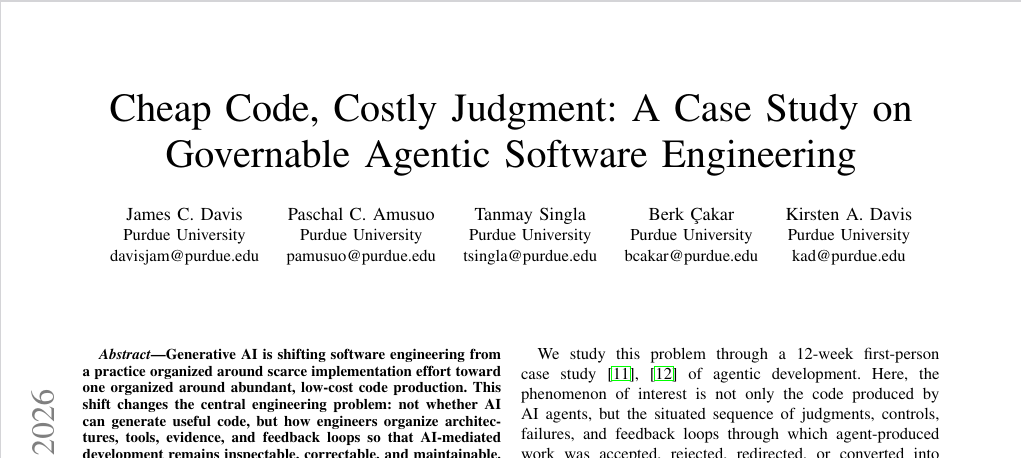
Discovered 10/29/2026
https://arxiv.org/pdf/2607.01087
https://github.com/davisjam/model-based-agentic-software-engineering
A friend of mine visited me recently. He’s a software engineer and a former PhD student in computer science. For the past few months he’s been in Bali; then, as soon as the plane made landfall, he decided to bike across America. Needless to say he’s missed the last few months of development in the software scene. During his visit, among the other million things we talked about, he showed me this paper. I thought it was pretty interesting and I promised him I’d respond to it, so here we are :)
The point of this blog post is to compare the paper’s process and theory to the way I’ve been articulating my own work since I switched to vibe coding full time. I’ll give my take on the paper before giving an overview of d3r, my agent workflow, and diving into an example of the paper’s failure → governance pipeline in my own work.
The paper
The process outlined in this paper is pretty much aligned with the way that I work, though perhaps a bit better articulated. The main idea is this: The authors want to find a middle ground between fully tokenmaxxed vibe-coded garbage slop (“velocity-centric development”, II.B.1) and overwrought human review for small code changes (“oversight-centric development”, II.B.2). Their middle-ground is governance-centrality, (II.B.3) which they more or less consider to be a heavily linted, pre-commit-hooked, tested, and documented codebase. I think they take this to a bit of an extreme – they end up with “88 contemporaneous filed notes, 420 KLOC of production code, and 1.16 MLOC of tests, lints, supporting documentation, and agent tooling”. What an unbalanced codebase!! – But nonetheless the theory they get out of it is quite useful. I want to focus on that part, more than the actual codebase they produced. They write,
[governance-centric development’s] central process is failure → governance: agentic velocity exposes structural failure classes, engineering judgment interprets those failures, and new governance mechanisms encode that judgment into the engineering environment to constrain subsequent agent work. […] In this account, the scarce human work is not implementation-level review, but recognizing which failures reveal missing governance and converting them into architecture and controls.
— (Davis et al. 2026), §I
This means the human stays in the loop. So the human’s job moves from writing the code directly to oversight of the architecture and development process as a whole. Explicitly, reading the code is not a necessary aspect of this. That might give some folks a big yuck, and it certainly isn’t good for every use. If you’re writing something genuinely new, something where the architecture doesn’t have an existing pattern, then you’re going to need substantial oversight until the model can understand what you’re doing. For the paper, they wrote about creating
a SAAS app which applies WCAG standards to slide-shows and PDFs. This has a very clear acceptance criteria and is focused on making the product as quickly as possible without it being a terrible, unmaintainable piece of work. I’ll talk below about some experimental work where the acceptance criteria wasn’t clear, but once it was the development process became about automation. The key to this automation is
a clear specification of the architecture, accessible across sessions to agents. Agents are always new to the codebase, so giving them context for what they’re working on is the highest priority. And what’s better, it is possible to strictly define this with model-based systems engineering (MBSE).
The classic retort to this is the slippery slope argument. Once you’re strictly defining your model, aren’t you just writing code? And yes, UML and SysLang are programming languages. But, they exist at a higher level of abstraction.
Consider this the shift from the software engineer as the man on the factory floor to software engineer as the man designing the factory. I mean this in the literal sense: the planner does not build the product, but only lays out the plans, often to very precise specifications. The blueprint is not the same as the product itself – we aren’t living in a Borges story – the goal is to lay out the idea and to provide the high-level specifications so that the automated process can do its work. The goal with governance-oriented vibe coding is to
create a balancing point between extreme reliability (requiring intense oversight) and extreme velocity, where the velocity is slightly slower but the product is quite reliable. It is a balancing act between limited human oversight budgets and limited tolerance for failure.
The goal with all of this is to produce a product that is both more reliable and cheaper than hand-written code alone could produce.
The same speed that can cause agentic technical debt can also make quality-improving changes more affordable and visible.
— (Davis et al. 2026), §VII.B.2
We’ve seen this enough in the wild that I don’t feel like it’s necessary to defend it anymore. Agentic coding can produce higher quality software more quickly. The question is how to do so. So let’s dig into the model.
When do we add governance, before failure (ex-ante) or after (ex-post)? The
paper suggests both. It takes this to be something a novel approach, though this seems pretty obvious to me. (Sometimes the most important thing is to
articulate the obvious.) These days, when models do something you don’t expect, it’s more often your fault than the model’s. This has not always been true, so I understand skepticism here, but over the past 6 months there has been a qualitative shift in the quality of model output. And at the very least, that is the proposition which this article wants to raise. The solution to this is stronger governance in the form of skills, AGENTS.md constraints, linters, etc. And notably, this architectural governance can transfer between projects. This much is pretty obvious from the proliferation of agent skills and the entire model context protocol. But each project needs its own governance, which is
often overlooked. The difference between the model offered in this repository and the status quo up until now is that the authors highly recommend committing this governance, including documentation, logs, skills, and agent deployment strategies.
As a solo developer, I think that’s quite nice. However, I worry about how this scales out to teams. The paper itself was written about a single project by a single man, meaning it hasn’t had the chance to attempt to scale to larger teams. I’d be curious to see how team projects use this sort of process. High velocity projects mean changes in governance can come with large changes in the output produced, on the order of thousands of lines of code. So I would hardly say we’re past the age of peer review, though again the focus is less on code quality and more on process quality.
A criticism of this though: There is a HUGE amount of non-production code being committed to this project. The vast majority of it is LLM-generated self-direction / guidance / governance in the form of documentation. The size of the product blows out a model’s context window (common), meaning each agent needs to have a very specific scope. Perhaps this is the trade-off between a highly-autonomous system (which Davis’ is) and a system with more human oversight and less governance. There certainly doesn’t seem to be any strong cut-off between velocity-centric and oversight-centric codebases – perhaps governance-centric is just a convenient term for the goldilocks zone between the two extremes.
Tightly-scoped agent contexts is an issue we had before LLMs too. In human teams, individuals have very specific tasks. Capitalism works because we hyper-specialize – this one is not just a software engineer, but specifically a front-end web developer with a focus on React, or a systems developer working on the Linux kernel with no knowledge of web dev at all. The career of the software developer in an industrial setting is to be the minuscule gear which makes the watch tick. But no longer! Instead of focusing on a specific domain, a software developer can now expand their scope to be a specialist in architecture for a specific domain, rather than a specific subset of that domain. And architectural knowledge from one domain often transfers to another. The entire idea of architectural knowledge is to abstract over the implementation details to see how the systems fit together. Once you know how to do it in one domain, you replace the parts but keep the knowledge. It’s category theory for software engineering.
An additional benefit, if you are skeptical of AI consciousness. There is no problem with treating LLMs as cogs in the machine. Taylorism-Fordism for the age of LLMs. In a way we’re de-Taylorizing our workplaces by moving our position from the individual worker to the petite bourgeois. Just think, for only $100/mo you too can own a piece of the means of (digital) production! (And perhaps in a more physical sense once custom hardware printers get off the ground.)1
We’ve been sliding into the “human judgment thesis,” the natural complement to the “engineering governance thesis” which I’ve articulated at the start of this section.
(a) The engineering governance thesis: Agentic velocity is possible, but is sustainable only when governance is relocated into the engineering environment rather than resting on human review. […]
(b) The human judgment thesis: When implementation becomes abundant, human work shifts toward problem framing, abstraction discovery, architectural judgment, and governance. […]
Synthesis: Together, the theses are duals: governance makes velocity sustainable, and judgment determines which governance should exist. Agents’ current implementation capabilities do not supply the structural interpretation needed to convert recurring failures into durable governance.
— (Davis et al. 2026), §VI.B.4
I believe this is quite similar to Grant Sanderson’s observation that mathematics is shifting toward theory-building rather than calculation. I’ve discussed this elsewhere, but long story short I think this is a huge win for STEM. For me, as a philosopher, theory-building has always been the whole point. Crunching the numbers (writing the code, calculating the syllogism), while an enjoyable activity and a necessary part of the craft of theory-building (software engineering, philosophizing), has never been the point. The applied mathematician wants to get something done. The theoretical mathematician wants to marvel in the beauty of the universe. Perhaps the technical mathematician just wants the joy of getting lost in the puzzle. This is a net loss for them, I have to admit, and that is sad. But the puzzle-solving isn’t going away. It’s always possible to learn these skills the same way it’s possible and necessary to learn how to do arithmetic even though we have calculators.
Overall, I think the Davis paper is quite useful as an articulation of the emerging best-practices for agentic development. I think the material codebase could be improved in myriad ways, but the theoretical basis it proposes is well-articulated, and as I’ll show below, it follows what I’ve seen elsewhere.
My process
Okay, that about sums up my feelings on the paper itself. Now let’s talk about ME !!! :D
I’m between jobs right now (hire me!), so I’ve had plenty of time to work on my game project. The game I want to make relies on some natural language processing, specifically argument mining from turn-based natural conversation. This isn’t a super well-studied field, so there aren’t a lot of tools available for me to steal use for my project. In order to make any progress, I’ve had to start spiking out an NLP pipeline. I’ll write more about it once I’ve got more solid results, but I wanted to note the similarities in my overall flow with the paper discussed above.
The Metarepo
First of all, I have something I call a metarepo. This is my overall project repository, where I keep agent context, notes, etc. It’s designed to capture the organization-level flow. For my game project, I created the qproj github org, which hosts all the repositories, and the corresponding workspace metarepo. This metarepo flow can be used wherever you need to work across many repositories. I came up with it while working on contract at Microsoft. It’s inspired by tools like Bazel, nix, and mani, but bespoke per-org and simplified.
The structure of qproj’s metarepo can be broken down into three intermingled layers. First, there’s the production code, which I’ve split between the
libraries and binaries. Each project get its own git repo. They’re designed to be independent. Nothing in the bin, lib, or misc folders (introduced below) gets committed to the metarepo.
├── bin
│   ├── quell
│   └── vn-jun-26
├── lib
│   ├── q_cam
│   ├── q_proc
│   ├── q_query_lang
│   ├── q_screens
│   ├── q_shell
│   ├── q_term
│   └── q_test_harness
├── misc
│   ├── dev
│   ├── forks
│   ├── infra
│   └── labs
The projects are managed in a meta-level Cargo workspace. This is the dev tooling layer. For the shared infrastructure, there’s the infra repo, which has scripts for CI across the github organization (maybe some day I’ll switch to tangled…); “dev” contains things like bespoke Zed extensions; “labs” contains spikes and experiments; “forks” is self-explanatory. This is a bevy project, so I’ve borrowed and extended the trait tags so the documentation for my libraries is clear. Additionally, there’s a justfile for common tasks, including repository management, which uses repos.yml (gitignored) as its basis.
├── .cargo
│   └── config.toml
├── docs-rs
│   └── trait-tags.html
├── misc
│   ├── dev
│   ├── forks
│   ├── infra
│   └── labs
├── .zed
│   └── settings.json
├── Cargo.lock
├── Cargo.toml
├── .envrc
├── .gitignore
├── justfile
├── pyrightconfig.json
├── README.md
├── repos.example.yml
└── rust-toolchain.toml
Then there’s the agent context directories, which includes skills and documentation.
├── .agents
│   └── skills
│       ├── bevy-queries
│       ├── q-cam -> ../../lib/q_cam/.agents/skills/q-cam
│       ├── q-os
│       ├── q-proc -> ../../lib/q_proc/.agents/skills/q-proc
│       ├── q-query-lang -> ../../lib/q_query_lang/.agents/skills/q-query-lang
│       ├── q-screens -> ../../lib/q_screens/.agents/skills/q-screens
│       ├── q-shell -> ../../lib/q_shell/.agents/skills/q-shell
│       ├── q-term -> ../../lib/q_term/.agents/skills/q-term
│       ├── q-test-harness -> ../../lib/q_test_harness/.agents/skills/q-test-harness
│       └── ...
├── .docs
│   ├── designs
│   │   ├── done
│   │   ├── retired
│   │   └── wont-do
│   ├── plans
│   │   ├── done
│   │   ├── retired
│   │   └── wont-do
│   └── reference
├── AGENTS.md
The documentation is, of course, quite helpful for me too. A lot of the time these documents are reflections on conversations I have with agents (which often test my assumptions and show me new ways of viewing the problem – they’re very valuable interlocutors!) And you’ll notice that each project repo has its own skill, as well as a skill (q-os) which covers general usage patterns cross-repo.
In general, the workflow follows the design scheme for d3r, an agent harness / workflow that I designed while at Microsoft Research. I’m no longer using that harness as it’s a bit too mechanically restrictive, but the overall flow is extremely useful. It’s a four-step process.
Design
The repository linked above has far more context on it, but the idea is pretty simple. Start by chatting with an agent in order to create a design document. This goes in .docs/designs/. The design document details the idea behind the unit of work, whether that’s an epic, a story, or a single PR. Designs are more commonly used for multi-PR work, but some complex changes might need a design on their own.
Delegate
The delegate phase breaks the design down into concrete steps. In d3r, this entails a subagent delegation plan. Work that can be parallelized should be (unless you’re trying to save tokens, which these days I definitely am). Delegation means creating implementation plans, recipes for PRs, more or less, that subagents can follow through without much reasoning effort.
Develop
The develop phase takes the recipes and implements them. There are two modes in d3r: semi-auto and fully-auto. The semi-auto mode is closer to a human-in-the-loop / high-oversight model. On perilous work, e.g. kernel code, this is worth doing to ensure the highest quality. It’s also quite useful if this is uncharted territory for agents. This is really useful for creating new governance – keeping yourself in the loop to watch over progress is like teaching somebody a new skill. You need to point to the failures as opportunities to learn. These get cemented in skills as you go along. In this workflow, the delegation work
and any existing skills act as the ex-ante governance, while skills act as ex-post governance. It’s a continuous cycle of improvement. Once agents
have proven themselves to write high-enough quality content, you can switch to fully-automatic and just let them chug along.
Review
The final stage is review. PRs are drafted and looked over; agents report on where they struggled and potential process improvements are noted. Sometimes these improvement suggestions are bunk (“it would improve my process if you just told me exactly what to do”), but they sometimes offer real insight.
xAIF: A Failure → Governance Case Study
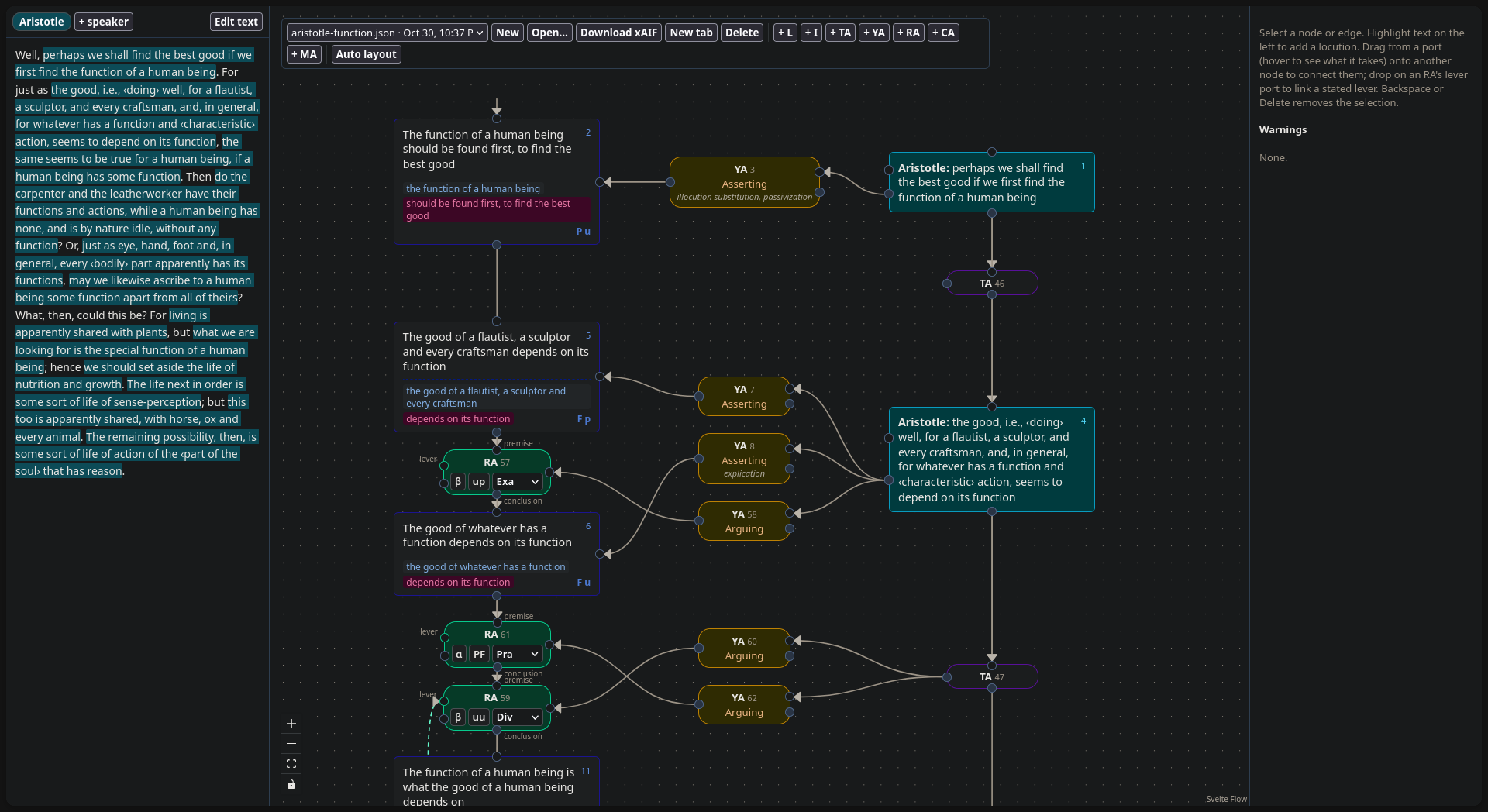
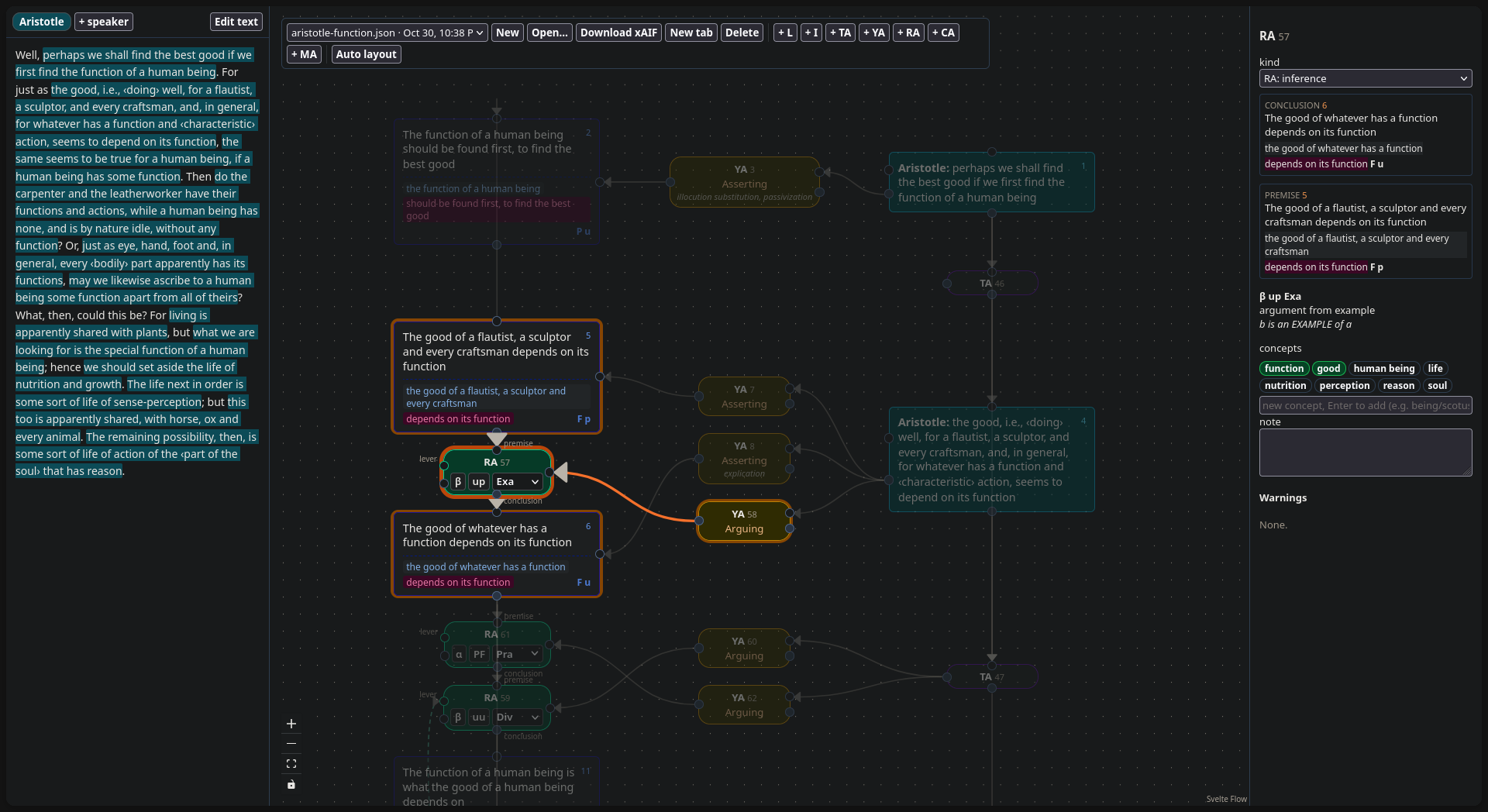
I’ve really been going to town with this workflow on the codebases where the final code quality doesn’t matter that much to me. Specifically in my labs, where I’m testing out ideas rather than polishing a performance-sensitive codebase.
As mentioned, I’m spiking an NLP pipeline for natural language argumentation. There has been some work on this in the past, but most of it has been natural language inference (NLI), which simply scores whether a posterior statement follows a prior one. It’s not a very precise model. There is current work in this field happening at the Centre for Argument Technology (ARG-tech) (github) at the University of Dundee. They’ve developed a model for mapping out reasoning called xAIF (the extended Argument Interchange Format), which is a JSON schema for defining natural language arguments. This is based on the Inference Anchoring Theory (IAT), which I believe the folks at ARG-tech also developed. I’ll save the details for a forthcoming postmortem on the project, as I’m still learning. Their website has been down lately, so I’m sure there’s a lot I’m missing!
This format is quite nice and it captures the structure of argumentation quite nicely, but it doesn’t help evaluate said argumentation. For this I’m experimenting with a strategy from (Hinton and Wagemans 2022), namely a combined strategy from the Comprehensive Assessment Procedure for Natural Argumentation (CAPNA) and the Argument Type Identification Procedure (ATIP), which itself is based on the
Period Table of Arguments (PTA). You can read more about the PTA and ATIP on Wageman’s website.
Currently, this has taken the form of a bespoke node-based implementation of the xAIF format, essentially an augmented rewrite of the OVA3 tool developed by ARG-Tech to better match my purposes. This tool is being used to identify argumentation structure, which is the first step in mechanically evaluating said argumentation.
Now for the relevant bit: This entire process is about the failure → governance pipeline. I am essentially training my LLMs to annotate arguments for me. The process follows typical NLP training: a decently large corpus of gold examples, followed by training on previously unseen data and evaluation thereof. The goal is to get an NLP model to read a natural argument and produce an xAIF JSON document. I have been annotating the arguments myself, using an LLM for review, and repeating that cycle until I am satisfied with the results. Unfortunately, the IAT, ATIP, and CAPNA still provide plenty of room for judgment and as of such are far from a mechanical process. They’re steps in that direction, but a lot of work needs to be done to clarify ambiguities.
The labeling process I describe above produces a document, judgement-calls.md, which an agent skill loads up and refers to when creating new labels. The process now is largely this: I give the model a snippet to annotate, it does so, I review it in the xAIF viewer, critique it, and we update the governance accordingly. I think a clean analogy can be drawn here between having the LLM produce governance via skills and an NLP pipeline producing a model via training data. The skill is the output of training, though not embedding; the NLP training gets cemented in model weights, whereas the LLM / natural language training gets cemented in governance docs.
Some folks have started experimenting with dynamic model embedding, though this is more for personality training than skill ascertainment. I don’t doubt that it could be used for something like this though. We humans are constantly re-embedding ourselves (our neurons are constantly changing their shape via neuroplasticity) – why not do the same thing for our models?2
Conclusion
I think that the Davis paper is pretty good, and it mirrors what I’ve been doing this whole time, and what I’ve seen emerging from some really smart people. If there’s anything to take from my reading it’s this: the space between vibe-coded slop and exhausting oversight is a spectrum parameterized by the level of automation you want. My example libraries, for spiking new ideas, require a fair bit more human oversight than Davis’ SAAS app, while my game dev projects, which take existing ideas and implement them, can rely more on automation since the domain space is more well-defined.
Bibliography
- Davis, James C., Paschal C. Amusuo, Tanmay Singla, Berk Çakar, and Kirsten A. Davis. 2026. Cheap Code, Costly Judgment: A Case Study on Governable Agentic Software Engineering. ArXiv.org. https://doi.org/10.48550/arXiv.2607.01087.
- Hinton, Martin, and Jean H. M. Wagemans. 2022. “Evaluating Reasoning in Natural Arguments: A Procedural Approach.” Argumentation 36 (1): 61–84. https://doi.org/10.1007/s10503-021-09555-1.